If you started having painful complications after breast surgery, you may not even realize mesh was used during the procedure. Many patients only discover products like GalaFLEX after requesting their operative records years later.
That discovery can raise hard questions. Was the mesh supposed to be used that way? Were the risks explained? Did the implant shift, harden, get infected, or lead to another operation? A GalaFLEX lawsuit review usually starts with the operative report, then looks at the timeline of complications that followed.
What Is GalaFLEX Breast Mesh?
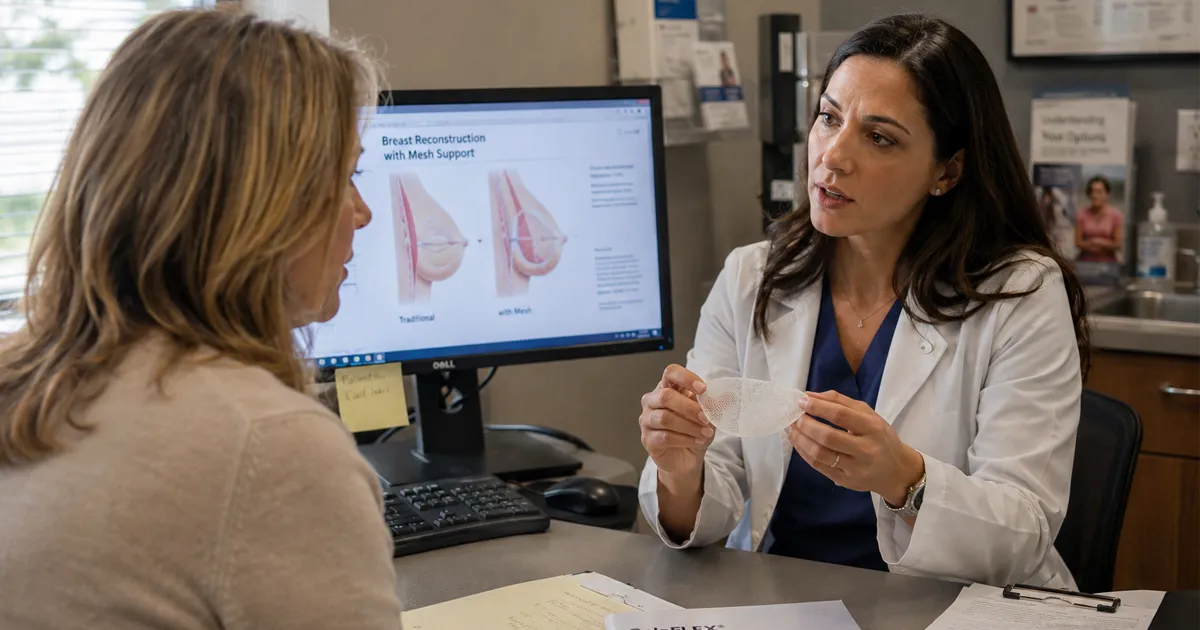
GalaFLEX is a surgical scaffold used to reinforce soft tissue. It is made from poly-4-hydroxybutyrate, often shortened to P4HB. In breast surgery, some patients are told mesh will work like an "internal bra" because it is used to help support tissue, implants, or the shape of the breast after surgery.
The FDA's public 510(k) database shows that GalaFLEX Mesh was cleared in 2014 as a surgical mesh product. Clearance does not mean the FDA approved it for every type of breast surgery.
The FDA has also addressed breast surgery specifically. In its breast implant surgery guidance, the agency explains that surgical mesh has not been cleared or approved for use with breast implants or in breast reconstruction. The FDA recommends that patients discuss the risks and benefits of mesh with their healthcare provider.
Why GalaFLEX Is Under Legal Scrutiny
Some patients report serious complications after GalaFLEX or similar mesh was used in breast surgery. The problems are not all the same. One person may deal with painful hardening. Another may have infection, wound breakdown, implant shifting, or a second surgery.
In November 2023, the FDA issued a letter to healthcare providers about labeling updates for BD mesh products, including GalaFLEX Lite Scaffold, GalaFLEX Scaffold, GalaFLEX 3D Scaffold, and GalaFLEX 3DR Scaffold. The FDA said these products were cleared for soft tissue support, but that their safety and effectiveness in breast surgery had not been determined by FDA.
For patients, the practical question is narrower: was mesh used, what were you told before surgery, and what complications came afterward? That is why the operative report and follow-up notes matter.
Breast Mesh Complications That May Matter
Breast surgery can go wrong even when no mesh is involved. But when mesh was used and serious complications followed, the records matter.
Some patients describe problems starting shortly after surgery. Others say things slowly got worse until they needed another operation.
Complications that may be important in a GalaFLEX breast mesh review include:
- Nerve damage: New or worsening nerve pain, numbness, burning, or sensitivity after the mesh was implanted.
- Infection or abscess: A serious infection, fluid pocket, wound issue, or abscess after surgery, especially when treatment did not resolve the problem quickly.
- Capsular contracture: Hardening or tightening around an implant that causes pain, distortion, or the need for more treatment.
- Seroma: Fluid buildup near the surgical site.
- Hematoma: Bleeding under the skin or around the implant pocket.
- Mesh migration or displacement: Movement, shifting, folding, or failure of the mesh support.
- Skin necrosis: Tissue death, wound breakdown, or exposed tissue after surgery.
- Reconstructive failure: A failed reconstruction or cosmetic outcome that required major correction.
- Implant rupture: A ruptured implant after surgery involving mesh support.
- Explant or revision surgery: Removal of mesh, removal of implants, or another surgery to repair the problem.
For most reviews, the operative report and records from later surgeries matter more than memory alone.
Breast Surgeries Where GalaFLEX May Have Been Used
GalaFLEX and similar mesh products may appear in reconstruction, implants, lifts, reductions, or revision procedures. A patient may not hear the word "mesh" during the first conversation with the surgeon, so it is worth checking the records if complications started later.
Common surgery types that may be reviewed include:
- Breast reconstruction after cancer surgery, trauma, or another medical condition.
- Breast augmentation with implants.
- Breast reduction where extra support was added.
- Revision surgery to fix implant malposition, bottoming out, capsular contracture, or a prior surgical result.
- Lift with implants where a surgeon used an internal support technique.
Medical literature shows GalaFLEX has been used in aesthetic breast surgery and revision procedures. One 100-case report indexed on PubMed described P4HB scaffold use in mastopexy, augmentation/mastopexy, and secondary correction procedures, while also noting that long-term evidence was still developing. Studies like this can explain where the product is used. They do not tell you what happened in your case.
What Records Can Help a Breast Implant Lawyer Review Your Claim?
If you are considering legal action, these are usually the most important records to gather:
- Operative report: This is often the most important record. It may say whether GalaFLEX, Phasix, ADM, scaffold, mesh, or an internal bra technique was used.
- Product stickers or implant logs: Hospitals and surgery centers often keep product stickers, catalog numbers, lot numbers, or implant records.
- Surgeon notes: Consultation, consent, and follow-up notes may show what you were told about the mesh and how complications were handled.
- Photos: Photos can help document visible wound breakdown, skin changes, asymmetry, implant position changes, or scarring.
- Imaging and lab results: Ultrasounds, MRIs, cultures, pathology reports, or infection workups may help connect the timeline.
- Revision or explant records: If you had another surgery, those records may explain what the surgeon found and whether mesh was removed.
- Billing and insurance records: These may help prove treatment dates and financial losses.
You do not need to have everything before asking for a review. Even partial records can help. The operative report and any records from later surgeries are the best starting point.
When Should You Ask for a GalaFLEX Case Review?
You may want a case review if all or most of these are true:
- You had breast reconstruction, implants, a lift, a reduction, or revision surgery in 2015 or later.
- GalaFLEX, GalaFLEX Lite, Phasix, or another breast mesh product may have been implanted.
- You later developed pain, hardening, infection, wound problems, implant shifting, rupture, or another serious complication.
- You needed ongoing treatment, revision surgery, explant surgery, or were left with lasting pain or visible changes.
- You were not clearly warned about the breast-surgery risks of mesh before the procedure.
Timing matters. State deadlines can limit how long you have to bring a claim. If you are unsure when the clock started, it is better to ask sooner rather than wait.
What Can a Breast Implant Lawyer Do?
A breast implant lawyer should not treat every complication as a product case. The review should be more practical than that. It should look at what product was used, what you were told, what went wrong, and whether the medical records point to a claim that can be pursued.
That review may include:
- Identifying the exact product used.
- Reviewing whether the product was used in breast surgery.
- Looking at the warnings, consent forms, and patient materials.
- Comparing the injury timeline to the surgery and revision records.
- Evaluating whether another cause is more likely.
- Checking filing deadlines for your state.
The goal is simple: find out whether the medical timeline, product records, and warnings support a possible legal claim.
Start With a Free Review
If you had GalaFLEX or another breast mesh product implanted during breast reconstruction, augmentation, reduction, lift, or revision surgery and later suffered serious complications, you may be eligible to pursue legal action. Start a free breast mesh lawsuit review to find out if your situation may qualify.
Start with what you have: surgery dates, surgeon names, facility names, product records, and any notes from follow-up or revision procedures. James Rolshouse Law Firm PLLC can review the information, help identify whether mesh was used, and explain your legal options. You pay nothing unless compensation is recovered for you.